Research editor: Nicholas Bauer, Founder & Research Editor · Updated November 6, 2026 · Research-based comparison
The R09 adds a softener. Decide whether that solves your problem.
Start with the R01 when you want a straightforward tank-filled dishwasher and its documented loading limits suit your dishes. Give the R09 more attention when adjustable water softening or its delayed-start controls are features you expect to use.
Both need filling access, drainage and space to open the door. Neither becomes an under-18-inch choice just because it is called compact. This comparison is based on manufacturer documents, not a hands-on cleaning contest.
R01: a practical baseline
Compare its current offer first if your priority is moving everyday plates and cups out of the sink and you do not need the R09’s softener.
R09: a specific reason to upgrade
Consider it when hard-water upkeep or scheduling matters enough to justify any extra purchase cost and salt maintenance.
What actually differs?
| Buying question | HAVA R01 | HAVA R09 |
|---|---|---|
| Water supply | 5-liter tank or faucet connection | 5-liter tank or faucet connection |
| Water softener | Not listed as an R01 feature in HAVA’s model comparison | Adjustable softener; dishwasher-salt instructions in the manual |
| Rated capacity | HAVA’s comparison lists two place settings | Manual lists three place settings |
| Scheduling and controls | HAVA’s comparison lists no delayed start or child lock | 1–18-hour delay and a control-button lock |
| Cabinet-height check | 18.05-inch manual / 18.1-inch product-page height | 18.05-inch manual / 18.1-inch product-page height |
Hard water: useful feature, extra upkeep
If mineral buildup is a known concern in your kitchen, the R09 offers something concrete to investigate. Its manual explains hardness settings and a separate salt reservoir. Check your actual water hardness and follow the setup directions; do not buy on the assumption that the appliance will cure every cloudy-glass problem.
If your water is already soft, the value case is different. Compare the price difference with how much you would use delayed start or the revised rack. The presence of a softener alone does not prove cleaner dishes or lower running costs.
Salt is a supply for the softener, not a detergent substitute. Our detergent guide separates format, dose and rinse-aid decisions so you do not buy a generic bundle that suits the wrong machine.
Three place settings does not guarantee room for your third meal
The capacity labels are manufacturer ratings. They do not tell you whether a large bowl crowds out your mugs, whether a pan blocks the spray arm, or how angled plates affect the rest of a load.
Write down your largest daily plate, the number of cups, and any awkward container you use every day. Then compare that list with each loading diagram. If your main reason for buying is a large item with unconfirmed fit, resolve it before ordering. Use the plate and loading worksheet to keep that decision concrete.
“Fits on the counter” needs a second check
Both machines use a top-fill tank. A counter spot can accommodate the body and still make filling awkward under a wall cabinet. Allow for the open door, hose routing and a secure drain destination too.
Both the R01 and R09 manuals differ slightly from their product-page size figures. For a tight opening, confirm the current US installation drawing rather than picking the smaller number. Our fit checker screens the R01 and Danby DDW631SDB only; it does not certify R09 fit.
Make the upgrade decision about your kitchen
Use this short decision note before the cost worksheet. It separates a feature you will use from an unresolved installation or water question.
Selections stay in this page. Your water test/report must apply to the water entering the appliance; an existing household softener can change that. Use the current R09 manual for hardness units, settings and salt directions.
What real-use R01 reports can tell you about this choice
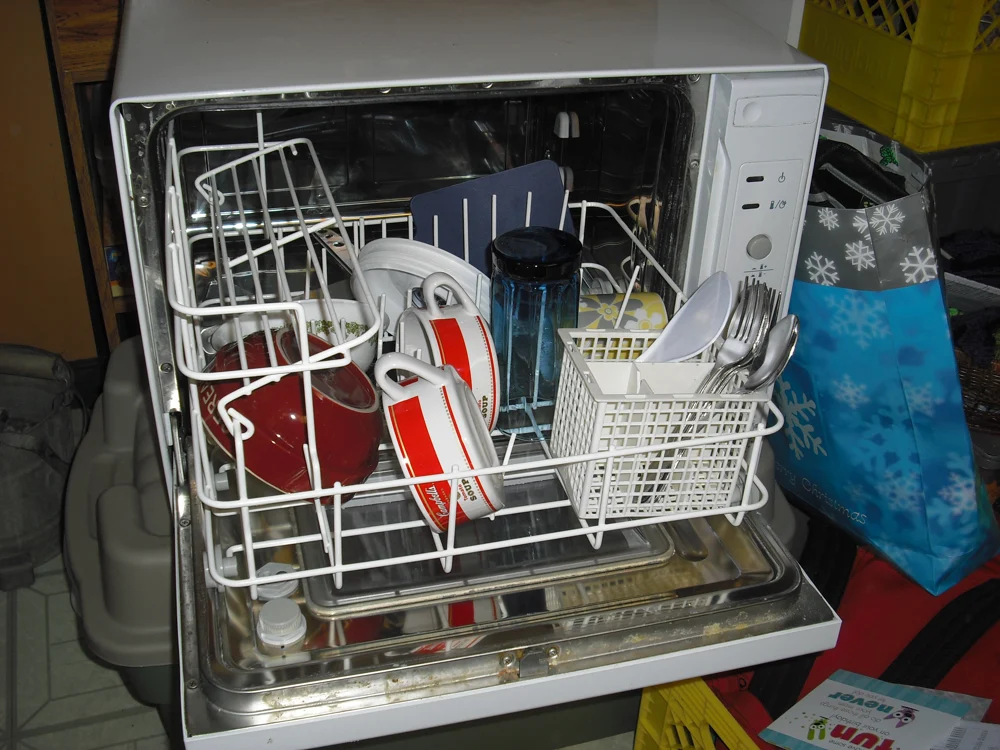
The credited hands-on reports in our R01 review give useful context about load spacing, usable capacity and drying. Those observations belong to the reviewers who performed the tests. They are not a side-by-side R01/R09 trial.
| Your question | Useful evidence | What remains unproven |
|---|---|---|
| Will it clear my usual sinkful? | Compare the reviewers’ actual dish arrangements with your own meal’s dishes and the current loading diagram. | A place-setting label does not establish the number of cycles your mixed load needs. |
| Does the R09 clean better? | Its manual documents extra features, including a softener. | The R01 reports do not measure an R09 cleaning advantage. |
| Is paying more worthwhile? | Your water evidence, desired controls, delivered quotes and upkeep budget. | A higher price or newer model number does not establish better reliability or financial savings. |
A practical next step: take one photo of the dishes from a normal meal, list the pieces that must share a wash, and note what you are happy to handwash. Use that list when comparing rack diagrams or asking the seller about a specific plate or bowl. Record your ordinary load.
Is the R09 upgrade worth its extra cost?
Separate the feature decision from the price decision. First confirm that both machines fit your space and dishes. Then compare what you would actually pay today, including delivery. A softener is useful only if it addresses your water conditions and you are willing to maintain it.
- Identify the problem: record your water-hardness result, the controls you would use and the dishes that must fit. An extra place-setting rating alone is not proof that your mixed load fits.
- Check the recurring task: review the R09’s salt-filling and warning-light guidance. If salt upkeep is a deal-breaker, include that in the choice before comparing offers.
- Price the difference: use the worksheet below to spread the extra purchase cost and your own salt budget over a chosen period. This is a budgeting calculation, not a prediction of product lifespan or savings.
Your upgrade-cost worksheet
Enter your own quotes in US dollars. No prices, salt-use rate or lifespan are assumed. Values stay in this page and are not submitted.
Fill in all five fields to compare your own offers.
Formula: (R09 price − R01 price + annual salt budget × years) ÷ (52 × years × weekly washes). This excludes electricity, water, repairs, detergent and resale value. We have not measured a running-cost advantage for either machine.
Worked example, not current prices: if the R09 costs $50 more, you budget $12 per year for salt, and you run five washes a week over three years, the extra budget is $86 across 780 washes—about $0.11 per wash. That number puts a cost beside the feature; it does not show that the upgrade will clean better or pay for itself.
HAVA lists a softener and delayed start for the R09. Those are manufacturer-listed features, not results from our own performance testing. Check HAVA’s current feature comparison.
Which one belongs on your counter?
Pay for the feature that solves your problem. The R09 softener adds a maintenance task as well as an option.
HAVA R01
Shortlist it when: you want a tank-filled baseline and the R09 additions do not solve a daily problem.
Resolve first: your mixed load, top-fill access and installation space.
Read the HAVA R01 research review →
HAVA R09
Shortlist it when: adjustable water softening or delayed start is a feature you expect to use.
Resolve first: water hardness, salt upkeep and the current exact-model dimensions.
Read the HAVA R09 research review →
Before ordering: match the full model code, condition, seller, delivery and return terms at Amazon. Prices and availability can change. These are research-based recommendations, not hands-on performance rankings.
Still unsure about the routine? Walk through the setup and supplies or check your everyday dishes before choosing.
Evidence behind the comparison
- HAVA R01 product page: water options, dimensions and loading guidance.
- HAVA R09 product page: HAVA’s R01/R09 comparison; these are manufacturer feature claims.
- R09 manual, printed page 8: capacity and dimensions. Printed pages 12–13: delay, control lock and softener instructions.
Manufacturer sources reviewed October 6, 2026. We have not independently tested washing, drying, noise or reliability. The kitchen photograph is lifestyle imagery, not evidence of product testing.
Two R01 size figures: what should you plan around?
HAVA’s product page lists 16.9 inches wide × 16.9 deep × 18.1 high. Its manual specification table lists 16.86 × 16.75 × 18.05 inches. Neither height fits a fixed 18-inch gap. Our checker uses the larger product-page dimensions for an initial screen.
Do not use the smaller figure to rescue a tight fit. Confirm the current US installation drawing, filling access, hose route and open-door space before ordering. See the R01 source checks for the limits behind these numbers.